The British Telegraph: “The U.S. Aircraft Carrier Truman Had a Tough Time”
Telegraph documents the cost of the Red Sea confrontation: mounting losses and operational errors under pressure from Sana’a government forces
NYN | Reports and Analyses
The British newspaper The Telegraph, in an extensive analysis by naval officer Tom Sharpe, revealed several of the losses and failures suffered by the U.S. Navy during its recent confrontation in the Red Sea, as part of operations launched by forces of the Sana’a government in support of Gaza.
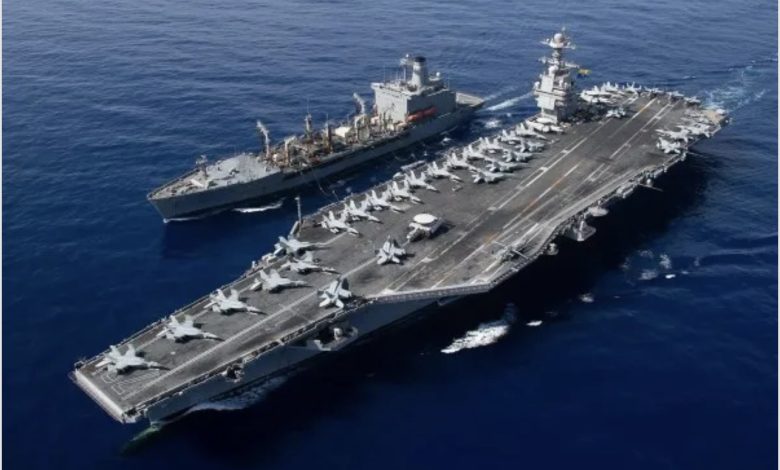
The paper concluded that the aircraft carrier USS Harry S. Truman went through “a tough time” during a short period marked by high operational pressure and a succession of costly incidents—financially and logistically.
The analysis, titled “Naval Aviation Is Much Harder Than It Looks in Top Gun,” used a cinematic contrast to compare Hollywood’s glossy portrayal with the complex reality of carrier operations. “Some say bad things happen in threes… but it seems in the U.S. Navy they happen in fours,” the paper quipped.
Four Incidents in Five Months… A Worrisome Picture
According to The Telegraph, a recent report covers four separate incidents involving the Truman within just five months.
These incidents included:
the shootdown of a jet by friendly fire,
a collision with a commercial vessel near the Suez Canal,
a sharp maneuver that caused a jet and tow tractor to fall off the flight deck,
and the loss of another jet from the bow after an arresting wire snapped.
The paper noted that cumulative losses—from destroyed aircraft and accidentally launched missiles, to subsequent repairs and upgrades—exceeded $285 million, though no fatalities were reported.
Friendly-Fire Shootdown Amid Red Sea Pressure
The analysis described the first event as the most striking.
On 22 December 2024, while the Truman was operating in the Red Sea during a day marked by intense and continuous U.S. strikes alongside defensive responses to waves of drone attacks, the guided-missile cruiser USS Gettysburgmisidentified two returning F/A-18 Super Hornets as incoming anti-ship missiles.
The cruiser fired two SM-2 missiles: one destroyed a jet after its crew ejected, and the second narrowly missed the other aircraft.
The report identified multiple causes: leadership gaps, inadequate training, a malfunctioning IFF system left disconnected and unreported, disjointed strike-group planning, conflicting orders, a radar gap during watch turnover, and a failure in the E-2D Hawkeye early-warning aircraft.
As the air-defense commander for the strike group, Gettysburg was assigned near-total responsibility for the incident, deemed a stark example of bypassing multiple safety layers. Its commanding officer was subsequently relieved.
Collision Near Port Said… Management and Navigation Failures
Weeks later, the Truman faced another mishap.
On 12 February 2025, while sailing at 19 knots through crowded waters near Port Said en route to the Suez Canal, it collided with the commercial ship M/V Besiktas-M, causing structural damage to the carrier’s hull.
Investigations uncovered a series of failures: poor crew oversight by the captain, weak intra-crew communication, failure to transmit AIS signals, inaccurate bridge logs, and the captain abandoning key navigational duties amid a “results-only” culture worsened by fatigue.
Sharpe stressed that entering the Suez at night is extremely complex, and that a 100,000-ton vessel traveling at such speed raises serious concerns. Repair costs reached $685,000.
Defensive Maneuver… and a $36 Million Aircraft Lost
On 18 April 2025, while the Truman was under attack in the Red Sea, it executed a sharp turn to improve its missile-defense posture.
At that moment, a Super Hornet being towed across the flight deck slid—along with the tow tractor—off the angled deck and into the sea. Two sailors jumped away in time and survived.
The report cited major faults: a failure in the aircraft’s braking system, degraded non-skid deck coating (unchanged since 2018), and poor coordination between the tower, flight deck, and hangar bay.
The lost aircraft was valued at $36 million.
Arresting Wire Failure… Another $60 Million Jet Lost
In a later incident, a Super Hornet landed successfully, catching the arresting wire—only for the wire to snap after deceleration, sending the jet off the carrier’s bow. The pilots ejected and survived.
The report cited inadequate maintenance (including a missing washer inside sealing mechanisms), ineffective quality checks, chronic staffing and training shortages, and leadership deficiencies. The mishap occurred after 52 consecutive days of flight operations.
The aircraft was valued at $60 million, with an additional $207,000 in cable and machinery repairs.
Fog of War—or a Deeper Problem?
After presenting the facts, the analysis posed a central question:
Are these incidents simply the result of high operational tempo and the fog of war, or do they reveal a deeper structural problem?
To frame the answer, Sharpe recalled 2017, when the U.S. Seventh Fleet suffered four major incidents in the Western Pacific—including groundings and collisions that killed 17 sailors.
The root causes then were clear: understaffing, operational exhaustion, inadequate training, eroded navigation skills, poor bridge resource management, disregard for basic maritime rules, malfunctioning or ignored equipment, and a “can-do” culture that discouraged reporting risks.
The Navy admitted fault and launched a surface-force readiness reform program—yet, eight years later, the parallels between the “new four” and the “old four” are striking.
Rigid Hierarchy and Overreliance on Technology
Sharpe noted organizational and behavioral issues within the U.S. Navy: strict hierarchy that may delay responses to dangerous situations, excessive caution among some officers that limits operational boldness, and an overreliance on technology that may erode human judgment.
He cited the Gettysburg incident as an example of pulling the trigger while relying on faulty systems, recalling a historical precedent—the 1988 shootdown of a civilian airliner—where human safeguards also failed.
A Culture of Exhaustion… When Ships and Captains Burn Out
The analysis pointed to an unspoken cultural issue: slogans like “sleep is for the weak” and a “never back off” mindset, arguing that constant maximum effort leads to crew and ship exhaustion.
Sharpe contrasted this with the sustainable model of “surge and recover,” versus the continuous depletion clearly reflected in the incidents.
Lessons for Others… and the Red Sea as a Stress Test
In conclusion, the analysis extracted broader lessons, affirming that even the world’s finest navies make mistakes under intense pressure. While the United States remains—according to Sharpe—a naval force capable of highly complex missions, the Red Sea confrontation exposed the limits of human and organizational readiness in an operational environment shaped by new strategic dynamics.
Between the lines, the report underscores that the operational pressure imposed by Sana’a government forces, coupled with multiple simultaneous threats in a single theater, became a revealing stress test—one that exposed a cluster of failures unlikely to surface as sharply under less demanding circumstances.
Thus, the “tough time” Truman went through signals more than just isolated incidents; it paints a broader picture of the cost of the confrontation in the Red Sea.