Hebrew Reading Reveals Israeli Bets in Yemen: The Resilience of Sanaa Government Forces Disrupts Maritime Control Calculations
An analysis by a Hebrew newspaper views the transformations in southern Yemen as a “strategic opportunity” for the occupation, while implicitly acknowledging that reduced pressure on Sanaa grants it growing military superiority
NYN | Reports and Analyses
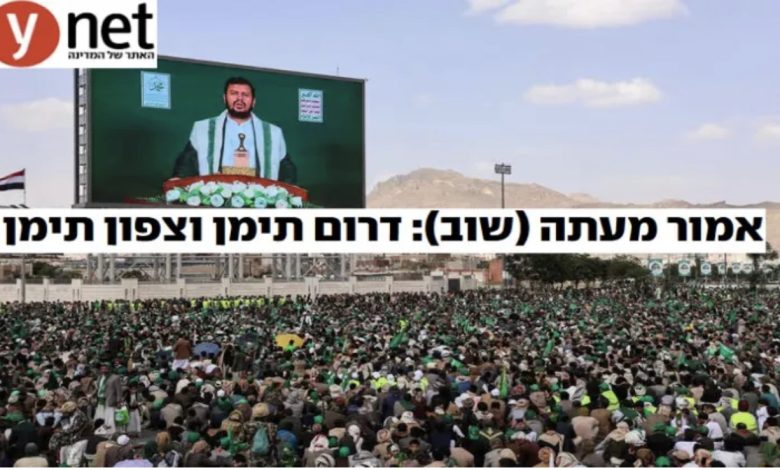
Hebrew media have devoted notable attention to the accelerating developments in the Yemeni scene amid political and military shifts in the south of the country, considering that the rise of the UAE-backed Southern Transitional Council represents a significant turning point in regional balances, with direct repercussions for the ambitions of the occupation entity in strategic maritime corridors.
According to an analysis published by the Hebrew newspaper Yedioth Ahronoth, the strengthening of the Southern Transitional Council’s influence places the occupation entity before two contradictory paths: one that raises security concerns, and another that opens the door to unprecedented strategic opportunities in the Arabian Sea and the Gulf of Aden—areas that have long constituted a security and economic obsession for Tel Aviv.
Two Contrasting Scenarios in the Hebrew View
The Hebrew analysis outlines two potential scenarios for the coming phase. The first begins with a warning that the continuation of conflict between factions aligned with Saudi Arabia on one side and the UAE-compliant Southern Transitional Council on the other would weaken the ability to exert multi-front pressure on the forces of the Sanaa Government.
In this context, the analysis implicitly acknowledges that such a situation grants Sanaa what it describes as “relative calm,” allowing it to invest time in developing its military capabilities—chiefly its missile arsenal and long-range drones—along with upgrading its defense systems, without facing effective field pressure. This, it notes, is a growing source of concern for decision-making circles within the occupation entity.
The “Golden Opportunity” from the Occupation’s Perspective
The second scenario, which the Hebrew newspaper describes as a “golden opportunity,” lies in the emergence of a stable, militarily disciplined southern entity that imposes control over strategic coastlines. According to the analysis, the occupation entity is betting on its close relations with Abu Dhabi to secure intelligence—and possibly military—presence, in addition to security and economic cooperation in areas under the Southern Transitional Council’s influence.
The analysis points out that this bet is based on previous statements by some STC leaders expressing openness to cooperation with the occupation entity, opening the door to partnerships that go beyond the security dimension to include economic and logistical aspects related to international shipping.
Yemeni Coastlines at the Heart of Ambitions
According to Yedioth Ahronoth, the consolidation of STC control over the ports of Aden and Mukalla, alongside the Emirati presence on the island of Socotra, would enhance the occupation entity’s ability to influence vital global trade routes.
The analysis argues that this maritime reach provides Tel Aviv with pressure tools extending from the Bab al-Mandab Strait and the Red Sea to the Suez Canal, in line with its historical pursuit of tightening control over the arteries of international navigation and securing its long-term economic and security interests.
Implicit Acknowledgment of the Solidity of the Sanaa Threat
Despite the Israeli bet on changes in southern Yemen, the Hebrew newspaper stressed that “the current situation does not immediately alter the threat posed by the Yemeni army to the occupation entity,” a clear acknowledgment of the continued effectiveness of the Sanaa Government’s forces and their ability to influence regional deterrence equations.
The analysis also noted that the so-called “new south” remains essentially subject to the Emirati agenda rather than being an independently decisive entity, which, according to the newspaper, requires Tel Aviv to adopt cautious diplomacy based on strengthening trust with Abu Dhabi while avoiding overt provocation—especially in light of ongoing regional competition between Riyadh and Abu Dhabi.
A Broader Project and Extended Hegemony
In concluding its analysis, Yedioth Ahronoth considered that the project of an independent southern state remains, from an Israeli perspective, a promising “strategic pledge,” referring to the facilitation it could offer for the occupation entity’s regional expansion ambitions.
The analysis links this aspiration to the pursuit of what is known as the “Greater Israel” project and dominance over the entire region, including its seas and vital corridors—set against a fixed reality: that the continued effectiveness and cohesion of the Sanaa Government’s forces remain the most significant obstacle to these plans.
Source: Yedioth Ahronoth (Hebrew newspaper)