Fragmentation Engineering in the Red Sea: Yemen as a Central Target in the New Israeli Plan
A study reveals the link between recognition of “Somaliland” and the deepening of Yemeni division within a single strategy to redraw maps of influence in the Red Sea.
NYN | Reports and Analyses
An analytical study published by the website Arabi21 has revealed that the rapidly unfolding developments on both shores of the Red Sea—most notably the Israeli enemy’s recognition of the secessionist “Somaliland” region, alongside the deepening state of division in southern Yemen—are part of an integrated geopolitical scheme and cannot be viewed as isolated or transient events.
Geopolitical Engineering to Reshape the Region
In his article, writer Nabil Al-Shaikhi argues that what is taking place in the Red Sea region falls within what he describes as “geopolitical fragmentation engineering,” aimed at redrawing maps of regional influence and transforming the area into a fragmented space controlled by non-Arab powers, foremost among them the United States and the Zionist entity.
The Red Sea: The Heart of the New Plan
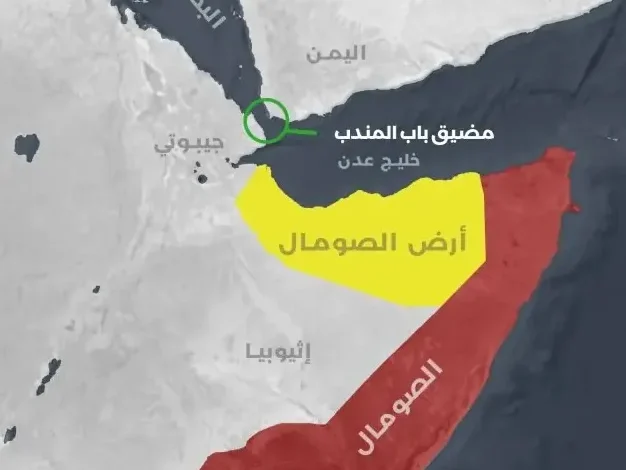
The article notes that the Red Sea has become a central axis of this strategy, as the Israeli enemy seeks—by reviving an updated version of the “Periphery Doctrine”—to overcome the limitations of its geography through establishing a presence along strategic maritime passages, most notably the Bab al-Mandeb Strait.
“Somaliland”: An Advanced Base on the Western Shore
The writer explains that the Zionist entity’s recognition of “Somaliland” grants it a strategic foothold on the western shore of the Red Sea, through a functional entity possessing long coastlines and sensitive locations that can be utilized as advanced security and intelligence bases serving its interests in the region.
Yemen at the Center of the Pincer
On the eastern shore, the article emphasizes that Yemen represents the second arm of the pincer of control. It notes that the course of the war is no longer a purely internal conflict, but has evolved into a systematic process aimed at dismantling the country’s political and geographical structure, in a manner that serves projects of domination over ports and maritime chokepoints.
Fracture in the Saudi–Emirati Alliance
The writer adds that the shift in the nature of the relationship between Saudi Arabia and the United Arab Emirates—from an alliance operating under the banner of restoring legitimacy to a state of strategic divergence—has directly contributed to strengthening separatist projects in southern Yemen. This has occurred through support for armed formations operating outside the framework of the state, in clear alignment with Israeli objectives in the region.
A Multi-Layered Equation of Influence
The article concludes that the current Yemeni landscape has produced a complex equation of influence, divided between Houthi control in the north and Emirati–Israeli influence in the south, with coastlines open to the Arabian Sea and the Bab al-Mandeb Strait, entrenching a dangerous state of geographical fluidity.
Call for Decisive Strategic Action
The study concludes by stressing that confronting this scheme requires firm and decisive Arab strategic action aimed at halting fragmentation projects and preventing the Red Sea—particularly the fragile Somali front—from being turned into an open arena for foreign domination.