Deutsche Welle: Turkey and Pakistan Will Not Fight Wars in Defense of Saudi Arabia
German report casts doubt on the capability of the Saudi-Turkish-Pakistani alliance to transform into a collective military defense umbrella.
NYN | Reports and Analyses
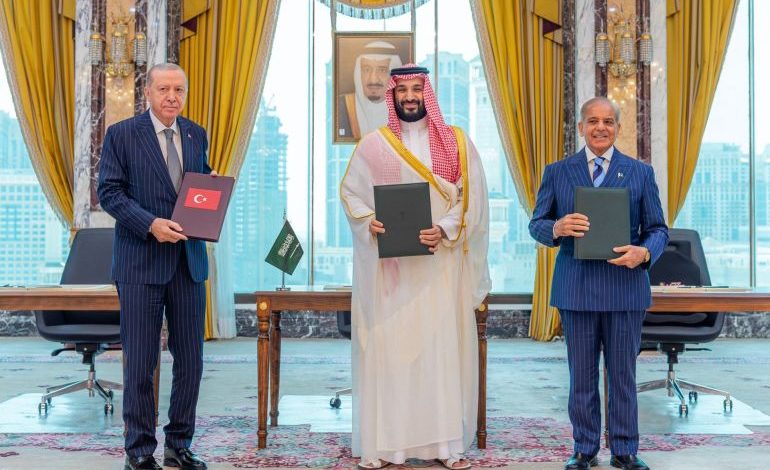
A report published by the German broadcaster Deutsche Welle cast doubt on the ability of the tripartite alliance uniting Saudi Arabia, Turkey, and Pakistan to provide a direct military defense umbrella for Riyadh, noting that Ankara and Islamabad appear unwilling to fight wars on Saudi Arabia’s behalf should it come under attack.
The report indicated that the success of the bloc in its current form remains doubtful, particularly given the absence of explicit language imposing a direct military obligation on Turkey and Pakistan to enter into any confrontation in defense of Saudi Arabia.
Absence of Military Intervention
The report drew on the attacks Saudi Arabia sustained just days after signing the tripartite agreement, pointing out that Turkey and Pakistan did not intervene militarily to defend Riyadh—a fact it viewed as reflecting the boundaries of the alliance’s actual commitments.
It added that Ankara and Islamabad are unlikely to engage in direct military confrontations with Iran or Yemen in the future, given the nature of the agreement and its stated objectives.
The “Mecca Agreement” Imposes No Military Obligation
The report quoted Dania Thafer, Executive Director of the Gulf International Forum in Washington, as saying that the document dubbed the “Mecca Agreement” does not represent a direct military commitment on the part of the signatories.
For his part, Andreas Krieg, Senior Lecturer in Security Studies at King’s College London, noted that the long-term goals of the alliance center primarily on defense cooperation rather than fighting wars or engaging in direct military confrontations.
A Gradually Evolving Alliance
Meanwhile, Kamran Bokhari, a scholar at the Middle East Policy Council in Washington, considered that the alliance will operate in stages, suggesting that its nature and goals could evolve over time based on regional developments and circumstances.
Western analysts believe that Riyadh seeks—through strengthening its partnership with Ankara and Islamabad—to leverage their ties with Iran, which could help lower the likelihood of being directly targeted and de-escalate regional tensions, rather than converting the alliance into a military force to wage proxy wars on its behalf.
A Defensive Alliance or a War Umbrella?
The German report concludes that Saudi reliance on the tripartite alliance as a full-fledged collective defense umbrella may run up against the limits of each party’s actual military commitments, especially if required to enter an open war with a regional actor.
According to the report’s analysis, the alliance in its current phase appears closer to an arrangement for political, defensive, and cooperative coordination than a binding military pact that forces Turkey and Pakistan to fight wars in defense of Saudi Arabia.