Middle East Eye: “Makkah Agreement” An Alliance on Paper; Divergent Threats Hinder Activation
A British report compares the trilateral alliance with UAE-Israeli cooperation, pointing to challenges in military integration and the lack of a direct response to attacks on Saudi Arabia.
NYN | Reports and Analyses
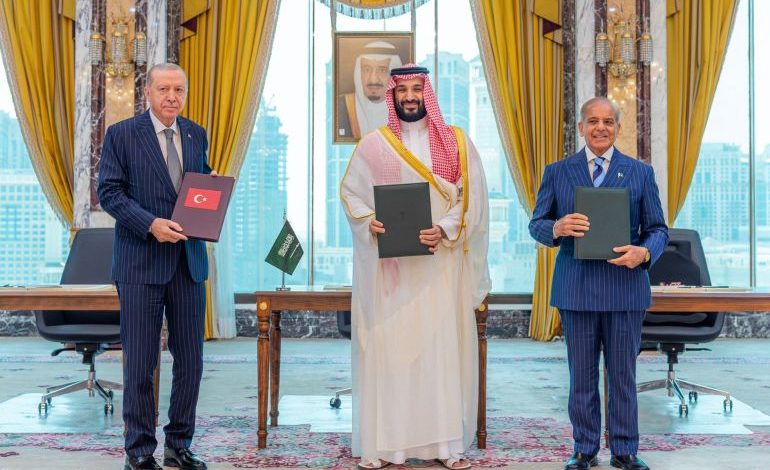
The British website Middle East Eye has highlighted the challenges facing the so-called “Makkah Agreement” between Saudi Arabia, Turkey, and Pakistan, noting that divergent regional environments and threat perceptions among its members limit its potential to evolve into an effective military alliance on the ground.
According to the outlet’s analysis, the agreement remains closer to an “alliance on paper” in its current phase, given the significant time, political will, and military effort required to develop mechanisms for coordination and integration among the three nations.
Divergent Environments and Threat Perceptions
The report noted that the primary challenges facing the trilateral alliance stem from differing priorities and threat perceptions, alongside Pakistan’s cautious stance and the relatively recent Saudi-Turkish rapprochement.
The website suggests these factors render building interoperability, as well as military and logistical integration among the three armies, a complex endeavor requiring extensive political and military arrangements before reaching actual coordination.
Comparison with UAE-Israeli Cooperation
The analysis drew a comparison between the “Makkah Agreement” and the military and security cooperation between the UAE and Israel. It noted that relations between Abu Dhabi and Tel Aviv developed through closed military and intelligence channels, allowing for a deeper level of coordination compared to the slower pace of the trilateral alliance.
According to the report, the difference lies not only in military capabilities but also in the degree of alignment between the parties and the nature of the threats they face, making the establishment of a joint defense system between Saudi Arabia, Turkey, and Pakistan far more complex.
Jizan Attacks and the Test of Defense Commitments
Middle East Eye pointed out that the agreement faced an early practical test following attacks on Saudi Arabia’s Jizan refinery, during which Riyadh did not witness direct military intervention from Turkey or Pakistan in its defense.
The site presents this incident as an indicator of the gap between declaring joint defense commitments and the capacity to swiftly translate them into a military response on the ground.
Potential for Future Expansion
Despite criticisms and obstacles, the analysis asserts that over the long run, the “Makkah Agreement” possesses opportunities to expand and foster broader regional partnerships. This potential offers an advantage not equally enjoyed by the UAE-Israel alliance, which faces limitations in regional acceptance due to ongoing political tensions.
The report concludes that the ultimate success of the trilateral agreement will depend not merely on its announcement or signed understandings, but on the ability of its parties to overcome conflicting priorities and establish clear mechanisms for military coordination and joint threat responses.