Western Media: Sanaa’s Capabilities Put “Mecca Alliance” to a Hard Test, Leaning Toward Indirect Support for Riyadh
American report deems direct Turkish or Pakistani military intervention against Yemen unlikely, suggesting support for Riyadh will focus on intelligence, early warning, air defense, and electronic warfare.
NYN | Reports and Analyses
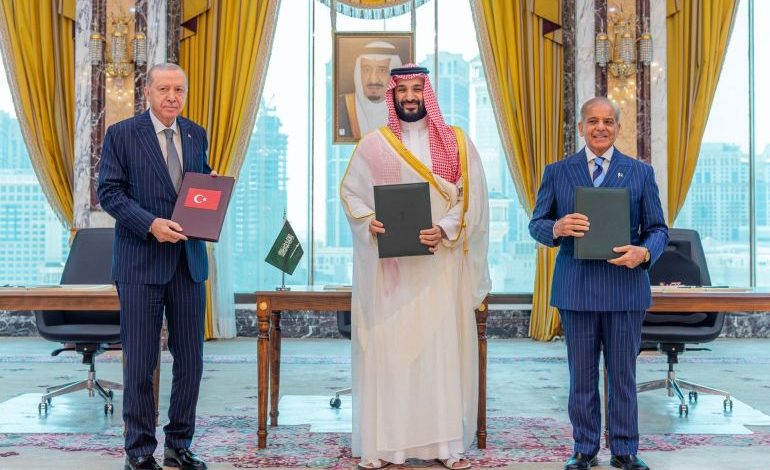
The American website Responsible Statecraft noted that the confrontation between Saudi Arabia and Yemen may represent the most prominent test for the tripartite agreement known as the “Mecca Alliance,” amid no clear indications thus far of any Turkish or Pakistani readiness to enter into a direct military confrontation against Yemen.
The outlet explained that Yemen’s missile, drone, and naval capabilities place the tripartite agreement before a gray zone whose details have not been publicly clarified—particularly regarding the nature of attacks that could trigger defensive commitments among the treaty’s signatories.
Sanaa’s Capabilities Impose a Test on the Alliance
The report indicated that Saudi Arabia is preparing for the possibility of its vital infrastructure—including energy facilities, ports, and airports—coming under Yemeni attacks, raising questions about how the alliance would respond to scenarios such as targeting an oil facility, a Saudi vessel, or a location within the Kingdom.
According to the website, the most critical question does not necessarily lie in whether Turkish or Pakistani troops would be deployed to Yemen, but rather in the nature of the military and security support Ankara and Islamabad might offer Riyadh.
Intelligence and Air Defense Over Ground Intervention
The report leaned toward the likelihood that potential support would encompass intelligence sharing, early warning, air defense, counter-drone operations, and maritime surveillance, alongside bolstering Saudi defensive capabilities.
It also highlighted the possibility of Riyadh leveraging Turkish and Pakistani expertise in electronic warfare, reconnaissance, and information sharing, thereby elevating its readiness to counter attacks without the need to deploy ground forces inside Yemen.
Raising Attack Costs Without Opening a New Front
Responsible Statecraft considers that bolstering early warning systems, air defense, intelligence, and counter-drone measures could raise the cost of Yemeni operations by improving detection speeds and neutralizing attacks before reaching their targets.
Conversely, according to the report, there are no clear indicators that the tripartite agreement is shifting toward direct military intervention, making the nature of defensive and security support one of the alliance’s most vital practical tests.
Complex U.S. Calculations
The website pointed out that developments present Washington with a difficult equation: while it seeks to support Saudi Arabia and enhance its defense capabilities, it may simultaneously harbor reservations about Riyadh engaging in a new military round against Yemen—fearing it could distract U.S. efforts, widen the confrontation, and raise military costs.
It added that a broader escalation could also impact the security of navigation and strategic straits, intensifying pressure on the United States and its allies while complicating their military calculations in the region.
Thus, the report concludes that the true test for the “Mecca Alliance” may not be the entry of Turkish or Pakistani forces onto the battlefield, but rather the alliance’s capacity to provide a defensive and intelligence umbrella for Riyadh without slipping into a direct military confrontation with Yemen.