Sayyid Khamenei’s Funeral Turns into a Political Message: Millions-Strong Crowds Confirm Iran’s Cohesion and Continuance of Strategic Path
The farewell ceremonies for the Leader of the Islamic Revolution transcend a funeral character to reaffirm Iranian domestic unity and the continuity of the Islamic Republic’s policies, despite the targeting of the absolute pinnacle of leadership.
NYN | Reports and Analyses
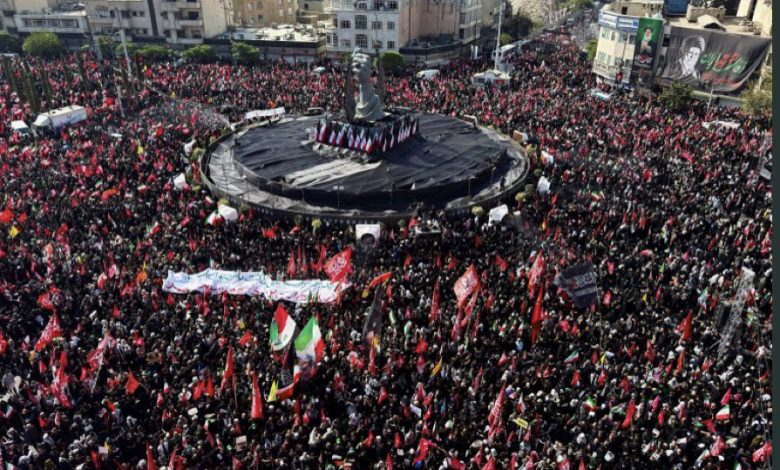
The funeral ceremonies for the martyred Leader of the Iranian Islamic Revolution, Ayatollah Sayyid Ali Al-Husseini Khamenei, turned into an extraordinary political and religious event, after the Iranian capital, Tehran, witnessed unprecedented mass crowds, reflecting the scale of influence the late leader enjoyed inside and outside Iran.
The “Tehran News” newspaper confirmed that the Imam Khomeini Mosalla (Grand Prayer Grounds) in the capital, Tehran, was packed with participants hours before the funeral prayer ceremonies commenced. This prompted Iranian authorities to close the entrances to the complex, while crowds continued to pour into the surrounding streets and squares to take part in the farewell ceremonies.
Millions-Strong Crowds and Slogans Affirm Commitment to Confrontation
Participants in the funeral procession chanted slogans against the United States and Israel, demanding revenge for the blood of the late leader, while raising red flags—which in Shia culture represent a symbol of demanding retribution and commitment to the cause.
Observers believe that the massive public participation carried clear political messages, meaning that the assassination of the Leader of the Islamic Revolution will not lead to weakening Iran or changing its strategic directions, but rather has reinforced popular cohesion and solidarity around state institutions.
A Message to the Home Front and Abroad
According to political assessments, the funeral ceremonies demonstrated the Islamic Republic’s ability to manage the leadership transition phase in an organized manner, reflecting the strength of its constitutional and political structure, and the continuity of its institutions in performing their duties despite the challenges they face.
The broad popular participation was also considered a message to Iran’s regional allies that the Islamic Republic’s policies and its support for its allies in the region will continue unchanged, and that targeting the highest pinnacle of leadership has not affected the state’s fundamentals or its strategic choices.
Funeral Schedule Extends to Iran and Iraq
The funeral ceremonies are scheduled to continue over the coming days, with the main procession being held in Tehran, followed by a memorial service in the city of Qom, before the body is transported to Iraq to visit the shrines of Imam Ali in Najaf and Imam Hussein in Karbala, amid expectations of massive public participation.
According to the announced schedule, the body will later be returned to Iran to be laid to rest at the shrine of Imam Reza in the city of Mashhad, the birthplace of the late leader.
Religious Symbolism and Strategic Messages
Observers view the route of the funeral ceremonies, extending from Tehran to Qom, then to Najaf and Karbala, and finally Mashhad, as carrying profound religious and political significance, reaffirming the continuity of the doctrinal and strategic ties that bind Iran with its allies in the region.
Furthermore, international participation in the funeral ceremonies, according to political estimates, reflected Iran’s ongoing presence on the regional and international stages, and demonstrated that the assassination of the Leader of the Revolution did not lead to the diplomatic isolation of the Islamic Republic, but rather strengthened its internal cohesion and reaffirmed the continuity of its political and strategic approach